


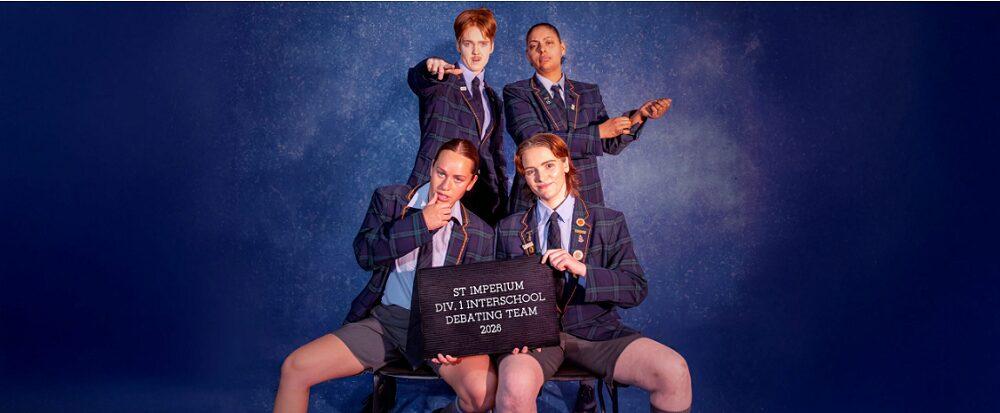
Recently, our Year 9–12 Drama students, alongside a Year 12 Essential English class, had the exciting opportunity to attend a live performance of Trophy Boys by Emmanuelle Mattana, presented by State Theatre Company South Australia. The experience was further enriched by a post-show Q&A with the cast, offering students a valuable insight into the creative and technical processes behind the production.
The performance sparked a wide range of reactions from students, highlighting both the engaging nature of the play and its exploration of complex social themes. Many students commented on the play’s balance of humour and seriousness, particularly its use of satire and exaggeration to explore ideas around gender, power, and identity. As one student reflected, the performance “used humor, satire, and exaggeration to get its message across… making it more engaging but also making me think more deeply about what was being said.”
For others, the experience was memorable for its energy and bold performance choices. “It was very funny,” one student shared, while another highlighted the “dance routine” as a standout moment, noting how the performers’ precision and commitment made the scene both entertaining and impactful. These moments of comedy were often contrasted with more intense scenes, creating a dynamic performance that kept students engaged throughout.
Students also demonstrated strong observational skills in analysing the actors’ use of dramatic techniques. Many noticed how physicality, facial expressions, and use of space helped bring characters to life. One student explained how “the way each character used the space showed the audience what they are really like,” while another recognised how lighting was used to direct audience focus and shape mood. These reflections show a growing understanding of how performance elements work together to communicate meaning.
The post-show Q&A provided an important extension to the learning experience. Students were particularly interested in how the actors developed and sustained their characters. One student noted, “to perform well you had to imagine yourself as the character,” highlighting the importance of fully embodying a role. Others were fascinated by the actors’ vocal work, especially how they trained to maintain character voices consistently throughout the performance.
Importantly, the production also challenged students to think critically about confronting themes. While some moments were described as unexpected or confronting, these responses opened up meaningful discussions about the role of theatre in addressing real-world issues. As one student reflected, the performance helped them “think differently about the topic of feminism” and consider perspectives they had not previously explored.
For several students, this experience extended beyond the theatre itself, influencing their own development as performers and creators. Many expressed an interest in applying what they had learned to their own work, from experimenting with body language and movement to using voice more effectively.
One student shared that the performance “changed the way I think about drama… making me more interested in creating work that is not just entertaining, but also meaningful.”
Perhaps most powerfully, the excursion also shifted perceptions of drama as a subject. One student admitted they were initially unsure about the class but reflected that they are now “quite enjoying it” and would “recommend it to other drama students,” demonstrating the impact that authentic, high-quality arts experiences can have on student engagement.
Experiences like this are invaluable in bringing classroom learning to life. By engaging with professional theatre and hearing directly from industry practitioners, students deepen their understanding of dramatic techniques, develop critical thinking skills, and are inspired to take creative risks in their own work.
We look forward to continuing to provide opportunities for our students to connect with the arts industry and experience the power of live performance.